Sunday, June 13, 2010

Sorsdal to Slushie and Still Cloudy

On Tuesday Adam, Matt A and me headed out to Kazak Island, which is about 10km South of Davis, on the quad-bikes, as part of Adam's work programme to download data from an automatic weather station there and to change the flash card in an automated SLR that takes photos of the ice in front of the Sorsdal Glacier when there is enough light. I've put a map here of the route we took. This photo was taken in summer, so all the dark blue water has been replaced with white ice, and would appear similar in colour to the Sorsdal Glacier at the bottom of the picture. The ice to the West of Kazak seems to break out all the time and at the start of our Summer season here I saw a cool timelapse video from this camera of it breaking and reforming again and again. This is for the same glaciology project for which I gather ice-thickness data every Thursday from the front of station. The area around Kazak is littered with islands and the ice in those parts usually takes a little longer to form due to tidal pressures around them, so as we went we had to drill every so often to make sure we weren't liable to fall through to a cold watery plight. We pulled up to the island, almost got bogged, backed off, and parked the quads about 100m from the shore. We left the engines ticking over to keep the quads warm and proceeded by foot to the island. As with every piece of land around here, Kazak is characterised by brown rocks with blown-snow making 'blizz tails' on the lee-side of them. During the summer, Kazak island is home to a large Adelie penguin rookery and, as is the case with such islands, is also completely covered in guano. Mmm, that old smell from the Summer, though somewhat muted, was there to grace our nostrils as we traversed. The thick guano is sprinkled with the corpses of dead penguins that gradually fade into it over the course of the seasons.

The AWS and the camera are on a small peak on the island, and when arrived the top we could see the huge whiteness of the frozen sea extending to the horizon to the North broken by the many islands surrounding.
Adam and Matty taking in the view while the data downloads.

To the South was the Sorsdal Glacier which was just visible behind another Kazak peak as a beautiful blue crumbly mess of broken, pressure-rended ice. It's interesting that the ice of icebergs and glaciers seem so much more blue under the light of clouds. After leaving the island we got some photos of us in front of the glacier and here I am standing in front of it.
Getting back from such a trip it's absolutely imperative to get yourself into the living quarters, sit in the 'wallow' and grab a cup of coffee. I know that the engine of the quad did most of the work, but trips out from station in the Winter really take it out of you.
On Thursday I was up until 2am or 3am the next morning sitting with station leader Ali, deputy station leader Mark and cross-dressing met observer Linc chatting and having a bit more of a get-to-know you session. That was a bad move because on Friday my alarm tore me from my comfy bed to crawl down to the kitchen and get started on my Slushy duties at 6:30. Every 3 weeks or so each person on station has to work a day in the kitchen, helping the chef wash dishes and keep the kitchen running. This time, though, I was reponsible for feeding all the pundits because 12 of the 25 of us, including chef Kim, had gone up to the Antarctic plateau to rehearse for the up-coming traverse to the Russian and Chinese stations. The idea was to find the most miserable, barren place possible and set up polar pyramid tents to simulate the conditions over their journey. Sounds like they had a rough time and we couldn't help but wonder about them that night as the winds at station, typically more calm than the plateau, were gusting about 40 knots (70kph).

Looking like some sort of ghastly pirate with my red eyes and striped shirt, I got to work making about 8kg of bread dough. The fruits of this were 6 fluffy loaves of bread, 12 cheese-contaminated bread-rolls, 24 pepperoni and cheese scrolls and 12 vegemite and cheese scrolls. Check out my baked-goods in the photos below. It all went down a treat. That night, for dinner I made, with the help of Ole Geoff Brealey and young Chris Wilko (two of the dieso's on station), bangers and mash for all of us, including the exhausted field party who had returned 2 hours beforehand. It all went really well except for the 'orange delicious' pudding I decided to make 90mins before dinnertime that ended up being a mess of coagulated egg and watery stuff. I got Kim to do an autopsy and the verdict: not enough flour! Bugger...

Me with my unbaked scrolls, wondering if they're too scrawny...

Some delicious loaves fresh from the oven.

The scrolls turned out to be pretty good

Saturday night was good with the usual delicious food. I wore more stripes, striped shirt, striped tie. Nichol told me that the stripes clashed with each other. I said I liked to 'buck the trends'. He replied with stunned silence. The crowd at the candlelit dinner table soon thinned and I was left among a small group of people for some good candid conversation about some of the events of the past Summer. It was interesting to get other people's views on some of those. At one point in the conversation, our resident coffee connoisseur, Nick "the rodent" Roden, walked in with a long black that he was sipping on. He is one of the pundits tackling the long traverse in a couple of weeks, and has been talking at length about how he's going to miss his beloved espresso coffee. Excusing himself to go to the bathroom, a few at the table became inspired and quickly got to work replicating his espresso coffee with a cup of instant. The amount of coffee in the glass was matched perfectly, and water from the cooler was added in appropriate proportions to the boiling mix in order to make the temperature just right. When Nick came back, Wellsy, Plant Inspector for the Winter, was interested to hear more about the coffee. As Nick sipped his 'espresso' Wellsy asked him "So, is it really that much better than instant coffee?"
It was totally suss, the whole table had gone dead silent and everyone was staring at Roden.
Nick: Oh yeah there's no comparison.
Grins widen. Roden sips.
Wellsy: Really? THAT coffee is really a lot better than instant.
Roden: Absolutely!
A short beat, then contained laughter erupted around the table.
Wellsy: You're drinking instant coffee!
Hahaha, but to Roden's credit he took it incredibly well and an explanation was offered: "You guys shouldn't take advantage of a drunk man!" haha it was too good. He really did take it with style though. I compared the two coffees and the espresso was a lot better. I guess unfortunate Roden didn't expect us to stoop so low.

Later on we were talking about the overnight jaunt that half the station had arrived home from the previous day. It seems that Frank the Tank* and Hellboy, while bailed up in their tent with a blizzard outside, had failed to fully seal the outer shell of the tent from the elements. They both woke up in the morning almost buried by snow-weighted tent-walls and they were certainly trapped in there. They thought about radioing for help, and Frank had a battery but no more of the required hardware. If only they'd buried the flaps of the outer shell of the tent in the snow, none of that would have happened. While laughing about this at the dinner table I said, completely innocently, "looks like Frank and Hellboy needed some more weight on their flaps.". Linc, wearing his usual Saturday dress, jumped up from his chair, went to the bar and wrote that straight in the Davis quote book.

You really have to watch what you say around here....

Until next week my friends, don't forget to keep an eye on your coffee and keep your flaps under wraps. Adios!

*Frank is our resident German painter. Every day at smoko break Andy, our senior comms officer, brings out short summaries of the Australian and world news. Earlier this week an article appeared in the world section entitled "Uproar! Germany Out!". Apparently, half the German team had been caught using a banned anabolic steroid and wouldn't be playing in the up-coming world cup. We all know this isn't true do to the complete flogging they gave the Socceroos last night, but it was all Frank could do to keep a weak smile on his reddened face. He was seen taking his smoko snack straight to his room to jump on the internet in order to verify this 'uproar'. Andy had cleverly doctored the article according to a scheme that the four of us had come up with while we were bailed up in Platcha Hut a few weekends ago. Tonight, Frank got his own back by presenting Andy with a box of tissues painted Aussie green and gold, with 'socceroos' carefully printed on the side, so that Andy would have something with which to wipe his loser Australian tears up with. We're still waiting for Roden's revenge.

Sunday, June 6, 2010

Blog Time Again

Hello internet,

So it's Sunday, and I'm going to write in this every Sunday. Just when I thought there was no chance that could keep a regular diary or journal I surprise myself by sitting down to my third entry in as many weeks. As Spaggers would say in his Italian accent: Not too bad.

The past week was a bit of slack one, work-wise, but I managed to get off my monthly report to all concerned. I also went back out onto the ice and did my drilling duties again, this time with the station leader, Ali. That was cool and we're still convinced, despite popular opinion going against us, that the holes that we've seen in the ice are not from a seal, but rather from meteorites. I think rejecting the meteor theory is like Kafuka in Sayonara Zetsubo Sensei saying ""How could [fantastic thing], something I've only seen on TV or in the newspaper, exist so close to me? This is obviously [improbable explanation]." I'll have to get some photos next time and put it out there... I mean how could a seal wear its teeth down grinding through 600mm of ice for a breathing hole and then just leave it to freeze over again, so that it would have to go and do it again? Anyway, that doesn't seem like a good habit to get into if you want to survive with your teeth intact, live and procreate.

Also, It's likely that I just want to believe in the meteor.

So the last few days of my life on station have been pretty social. We had Friday night in the bar, sitting around having a great laugh. Not much to speak about there. I tried to relay a description of the conversation that night to Bianca and the only thing worse than telling a 'had to be there' joke to someone face-to-face is writing it in an email. I still sent it off anyway. By the end of the night, there were five of us at the bar, practically in tears!

Then the next day, after I went to the gym, Hellboy put on a game of 'Beersbee' in the Green Store building, which is the storage facility for practically everything on station. Inside is an electrically-powered compactus that moves at the push of a button, which is fortunate because each of the aisles is about 3 stories high. Hellboy and Spaggers had moved all the aisles to one side and set up the playing court. Now, Beersbie is a game that combines two of Hellboy's favourite things. As Roachy, the electrician who lives in the room next door to me would say "three guesses as to what those things are and the first two don't count". So, first two PVC pipes, about 1.2m in length are stood up on their ends and opposite ends of the corridor. Then an empty can of carlton draught beer is placed gingerly on each of the upright pipes. Behind these precarious structures stand the participants from each team. Each team usually had about three people, and we had two frisbees that flew beautifully and a bucket lid that flew fairly well when hurled at dangerous speeds. The object of the game is that the teams take turns and each member of the team throws a frisbee (or bucket lid) at the upright PVC pipe, knocking it over. If you knock the can and it hits the ground, you get two points. If the other team catches the can, that's nothing, and you have to drink. If you miss the pipe, the frisbee wasn't 'uncatchable', and the other guys don't catch it, it's one point. The game was cool. I think Adam was the best wickie keeper and caught about 3/4 of the cans we knocked off, which was "f'n annoying" whined Hellboy. Yeah it frickin was. It was perfect timing though one time when the timed lights flicked off when Adam was in mid-dive for a classic catch of the carlton can. Tom the Plumber said "hey, we all play with the timed lights!". That we do, Tom, that we do.

Anyway after those shenanigans it was time for Saturday dinner. Every Saturday at Davis the tables in the mess are moved out from their lineup and pushed together to make one huge table. The tablecloths, candles, collared-shirts, ties, wine, and sometimes even station-supplied liquor come out, and the chef puts on an extra-special spread for all of us. This time it was slow cooked pork fillet, a chicken dish that I've unfortunately forgotten the name of, huge king prawns with seafood sauce, and vegies, finished off with a rich chocolate pudding with chocolate sauce, cream and ice-cream. When I was doing my training in Hobart, I remember hearing that most of the people that come down here put on weight during the course of the year. Now I can see why. I didn't imagine that I'd have to come to Antarctica to eat this well. We then went to the bar and watched Sam Stosur lose the tennis. Bugger. Yeah, we aren't doing it that tough; we can eat prawns and pudding and stream TV and radio.

When I get back I reckon I'm going to be totally useless in the kitchen, not having made anything on a regular basis for 17 months. Other things that I will unfamiliar with: paying for things, not saying hi to everyone I see, walking on concrete, trees, humidity, traffic, most of the music from the past year, anything new from the past year. The list goes on but being deprived and separated from the things that I'm familiar with has given me so much food for thought and allowed me a realignment of perspective. I won't go into my intimate thoughts, but I will say that my time down here has been, and will continue to be, a life-changing experience.

Tuesday, June 1, 2010

Laser Broke So I Went on a Trip

During the Winter it is one of my obligations to run the lidar for a few sessions that comprise more than two full days of consecutive observing each. Adam, electronics engineer that I mentioned in the last post, and I decided to get an early start last week when the forecasting models predicted a 3-day break in the clouds. May at Davis Station has been marred with constant cloud so this seemed like a perfect opportunity.

The lidar is capable of recording data that will give temperatures up to about 80km, though the higher you look, the more sensitive-a-detector you must use, and so are more likely to damage the detector with strong backscatter from low-altitude signals. We're still interested in the whole atmosphere; from tropo-, through strato-, into a big chuck of the meso-sphere, so we run a 'combined schedule' that spends about 48 minutes gathering data at altitudes at 20km-80km then quickly switches to gathering data from about 5km-40km for 8 minutes, just to make sure there aren't any sneaky clouds hovering around 20km. You see, in the next few weeks, we expect to see increasing detections of Polar Stratospheric Clouds (or PSC's) at this altitude. These clouds are interesting because they act as a catalyst for the breakdown of ozone. The small particles in the clouds provide surface area for chemical reactions to take place that allow the chlorine free-radicals from CFC's to snatch one of the oxygen atoms from the O3. I think I mentioned something about this in my last post. The more clouds we see, the bigger we should expect the ozone hole to be. By comparing our detection of PSC's with the ozone-concentration data gathered from the big ozonesonde weather-balloons that the slackers from Met let off once a week, we get more data about the relationship between the two.

So we ran the lidar doing some haphazard kinds-of shifts that somehow had me working till 6am the first morning, and then switching so as to be up at 7am the following morning for slushy, aka. kitchen duty that each station member does every 25 days. It didn't help that upon finishing up at 2am the night before I decided to join Chris the Dieso in getting pissed for his birthday and retiring 2hrs30mins before I was required to start said duties. Well, I was only 40 minutes late! Thanks Adam for backing me up on this too.

During the guts of the Thursday (we ran lidar from 5pm Wed to 6pm Fri) I went out and performed my weekly duty of ice-drilling at 7 sites out the front of station with Nick "the Rodent" Roden, a met observer and amateur film-maker that keeps putting cameras in our faces. Bother us now it may, but I reckon we'll be pretty stoked to have his footage when we get back home. Anyway, wrt to the sea-ice drilling, I'll put up a map of the location of the sites where we drill because it'll make it seem real to you. I really enjoy doing this because it's a weekly reason to get out on the quad bikes for some fresh air. Our measurements show that the ice has been growing consistently and is now about 85cm thick in places. This is more than enough to support heavy machinery, let alone people, quad bikes, and hagglunds.

So anyway not long after I got back from the ice-drilling and got some more sleep and then took over from Adam (to begin the evening with the finishing at 2 and the drinking and the like), the laser power started reading 13W, as opposed to its usual 25W that I'm so comfortable and familiar with. Shit. I shut down the laser and blasted all the optics with high-pressure air so as to remove any bits of dust etc that may be diverting some of the laser power from its path up the chimney and into the sky. This didn't seem to have any effect. I checked that the laser power meter was not playing up by substituting the spare detector-head and this didn't do anything either. Bugger. This isn't something that you want to deal with; there were a range of possible problems that may be causing this and many of the solutions involve painstaking hours twiddling mirrors with an ever-present feeling of futility looming overhead. Adam and I decided that the twiddling and the futility could wait, and that we would take advantage of the rare clear skies and finish our marathon observation, worrying about the tiny problem of the laser being half-broken at some other time.

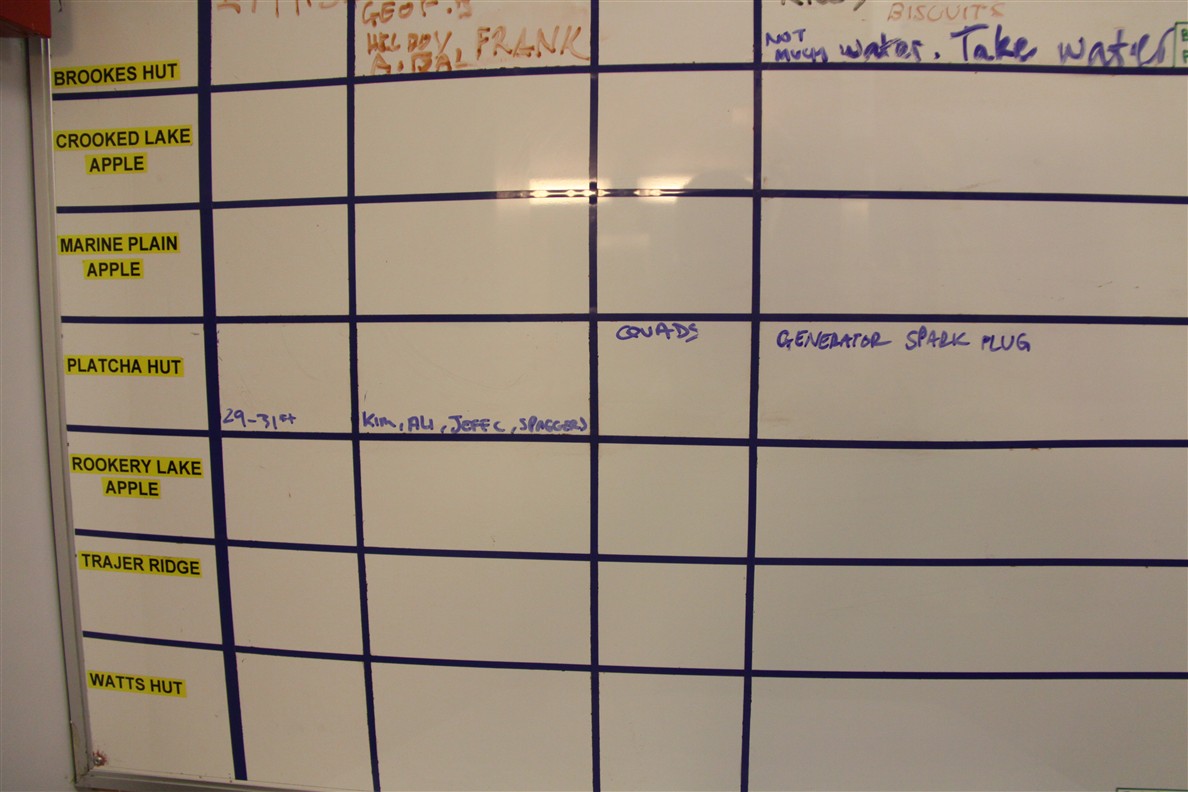
So we finished our observation, limping along at 13W. I packed things up, sent off the data, and went down for some dinner and sleep. The next day I would be going out on a jolly, or field-trip, to Platcha Hut and I made sure I got a lot of rest. See, you can see my name on the whiteboard to the left. The ailing laser was in the back of my mind and I felt a slight but easily-suppressed twinge of guilt the next day as we rode out over the sea-ice away from the colourful buildings of the station. The sun was rising/setting the whole time we were riding, providing some amazing fiery reds and oranges that complement the blues and whites of the icebergs and sea-ice. The air was nice and still, and I think it was about -15 that day, which isn't so cold when you've got the right gear on and the electronic hand-warmers on the quad hand-grips are firing away. We drove north up the coast and then diverted into Long Fjord, which is just as thick as the frozen sea-ice, all the way east towards Platcha Hut. The ride went smoothly for the most. Exception: at one point, while pushing through a geographical bottleneck so determinedly, with visors down and heads to the howling wind, the two of us at the front had forgotten to turn around and perform our regular check to see how our companions were travelling. By the time Ali and I looked back we could barely see Kim and Spaggers, far behind us in the narrowest part of the wind funnel. Turning, back we returned to this now inexplicably calm section of ice running between two hills to see that the two stragglers were utterly bogged; snow up to their footpegs. It took the muscle of 4 people and a barely-gripping quad to reverse the thing out of the slush, but we did it. The most concerning thing about this was that under the snow the wheels of the quads were splashing up water, which implies a breach in the ice underneath at some point. Nobody fell through, but we have noted that it would be better for other travellers to take a mapped-detour to the right next time. We just don't know where that water came from.

So we got to the hut and spent two nights there. We were all treated with wonderful food from our excellent chef Kim and with good conversation from each other. Good weather wasn't so forthcoming so we spent the whole weekend holed-up in the tiny cabin reading, doing puzzles, chatting and sharing meals and drinks. It was a wonderful and relaxing time, and I was sorry when it came to an end. We headed back to station yesterday and arrived back at 2pm. I did nothing for the rest of the day and found it pretty hard to do anything today as well. Going out the hut had put me down a gear and I was still trying to spin-up until about 3pm today. Here I've added a picture of Kim, Ali, and Spaggers enjoying some warm chocolate custard for dessert. You can see me bowl behind Ali's, waiting to be set upon by me right after I put down the camera.

Now here I am and I've gone and written all this which has caused me to become alert and enthusiastic at 11:30pm. Ah doesn't matter. If there's something I hardly ever have trouble doing, it's sleeping, which I'll go and do now.

See ya later. I'll put some photos up later on. I didn't take too many though. It takes you outta the moment too much and I don't like it.

Also, at noon today I discovered that the laser is fine, and that the problem was some sort of glitch with the power meter. Crisis averted.

Goodbye. May delicious chocolate custard warm your bellies this Winter.

Really, Really, Really tasty

Sunday, May 23, 2010

Winter is here

Hi everyone,

I'm sitting in the living quarters at Davis station. It's 9:20pm and three other expeditioners are sitting with me; Adam and Nichol working on their digital SLR's, and Zupy (Mike Zupanc) opposite me eating a piece of toast with his frostbitten, bandaged fingers. Adam is the electronics engineer with whom I work closely on the lidar and other ice-related studies, Nichol in a communications technician who is the gatekeeper of our link to the outside world, and poor Zupy with his frostbite is a carpenter that was down here for the Summer of 2008/09 and decided to come back for a Winter. Zupy arrived on Voyage 4 with four other new Winter crew, which was the last voyage for the season that took all of our summerers away, including Bianca.

Our new station leader, Ali, arrived on the last voyage. She's the only woman on station for the 8 months of Winter. She's a very relaxed and friendly woman that sets a nice tone for the social environment down here. The crew this Winter comprise a range of characters; Frank the german painter who says a lot that isn't understood, Spaggers (Rob Lemme) "the youngest plumber to ever set foot in Antarctica", as it said on the walls of the recently-burnt smokers' hut, is always there to give Frank a hard time about it (though Frank gets his own back in what ends up being the kind of banter that money can't buy). Nichol is the comms-tech-cum-brewmaster and is often seen over at the now-deserted science building growing his special blend of Antarctic yeast. He is also often seen talking 4WDing with Wellsy, the PI (plant inspector, or head-dieso) who doesn't seem to do anything by halves. Then there's Matt Azzopardi, who is an electrician that I suspect is trying to create his own army of Antarctic heroes by prescribing his well-thought-out gym programmes to those of us who are keen to tear up our muscles on a daily basis by repeatedly lifting weights in the gym situated above the floor of the storage facility. I have completed a two-month workout programme with the view of conditioning my body for the 'Azzopardi Plus' workout programme that I just started last Monday. I'm already seeing improvements in my fitness. Here's a picture of the gym.

There are 25 of us on station now. I recently learnt that in middle-aged agrarian economies that the average amount of space available to each individual at a given time is used as an index to quantify quality of life. I believe that this is true. This is paralleled here with the amount of living space that we all have to move around and socialise in being effectively tripled since the last of the Summerers left. This issue is not so simple though; I miss a lot of the people that were here over the Summer. We're all in a routine now and some of the vibrance of the Summer has gone. On the balance of things, though, I have to say that I prefer the Winter phase of my Antarctic experience.

A few days after the last voyage left, the sea started to freeze in earnest, and over the following two months until now we have seen a steady increase in its thickness. Incidentally, it's one of my volunteer duties to travel out onto the ice, drill through it, and measure the ice-thickness one time per week. This has a dual purpose; one is to provide ice-formation data to Petra Heil, a glaciologist back at UTAS who uses it for her research, and the other, far more pertinent to life down here, is to provide data to the station leader so that she can open up the ice for vehicular recreational travel across the top of the ocean. In this picture you can see Adam with the sea-ice drill and Andy with his ice-axe heading out for an ice-drilling jaunt. It all paid off last week, when we finally got the go-ahead to hop onto the quad-bikes and burn out to the field huts that dot the Vestfold Hills around Davis Station (it was on one such journey this weekend that Zupy's fingers got frostbitten). My turn comes next weekend. I have my name on the whiteboard out in the foyer to head out on a trip to Platcha Hut, which lies at the end of Long Fjord at the base of the Antarctic Plateau. I'll be heading out with Ali the Station Leader, Kim the Chef, and Spaggers the Plumber. I'm really looking forward to it.

I have been keeping in touch with my girlfriend Bianca on a daily basis. These conversations are a daily ray of sunshine that is much needed as the Sun starts to dip below the horizon toward the much anticipated six-weeks-of-darkness. This darkness will be characterised by long hours of twilight in the middle of the day but the Sun and his smiling face won't be seen during this time.

At the moment, the Sun is up for 3 hours per day and even then it is at a very low angle and often attenuated by cloud. I swear sometimes that I feel the effects of the lack of Sun, whether it be manifest as a lack of energy or a low mood. This fact was brought home this past week. I was rostered to attend the hydroponics shed once a day in order to ensure that the water levels for the plants were at a prescribed level. This job usually takes about 10 minutes. Often, while filling up the second or third water container I would find myself singing to myself or feeling a rising enthusiasm washing over my body. I reckon the sun-mimicking lights, humidity, and greenery were doing their bit to re-energise me. The sun disappeared so gradually it's hard to monitor the effects that its absence may have, but the sudden addition of Sun, artificial or no, is something that brought this home to me. I've decided that it will be a good idea to spend my daily reading time in the hydro hut. It can only be a good thing.

I haven't been running the lidar for the last month or so due to the excessive cloud cover that we've been experiencing. Instead, I've busied myself, with the help of Adam, in setting up and characterising POLAR, an addition to the lidar receiving telescope. The addition of POLAR will enable us to discriminate the polarisation of the light that returns back to the lidar after reflecting off clouds and other aerosols in the atmosphere. With this information we will be able to determine whether the light has been reflected by a solid, liquid or gas. This will be a nice addition to the data around characterising the formation of Polar Stratospheric Clouds (PSC's), clouds that appear in Winter in the stratosphere and play a catalytic role in the breakdown of ozone. The ozone hole is still under investigation. Before I started this job, I thought we'd more-or-less dealt with that, but atmospheric processes that occur above the troposphere are less well understood than those that occur in our home-layer.

Well, it's 10:10 now so I'm going to start thinking about bed and maybe putting some photos into this entry to spruce it up a bit. To all those who I have neglected to contact, I'm sorry, but it's so easy to get caught up in things down here. Please write to me and I promise I'll respond.

Okay, good night all. I hope you're enjoying life, whatever you're doing.

Andy and I having a chat in the smokers' hut
before the fire.

Monday, January 18, 2010

Christmas and the Amery Ice Shelf

It's been a while since I've found the motivation to write in my blog, but here I am again to tell you who are interested what I've been up to for the last month.

A lot has happened and as is usually the case it feels like the time has gone extremely fast, while at the same time giving the impression that much more time has passed than actually has. Perhaps that doesn't make sense, but I've always found this particular sensation hard to explain.

Christmas day was amazing. We had a visit from a short and skinny santa claus, who would deal out gifts to each and every one of us provided we sit on his lap, and his loyal elves who I think were all at least 2 metres tall. It was a twisted christmas scene. I'm not sure, but I think santa was getting a little 'handsy' with some of the females.

From my secret santa I received a survival kit for the then up-and-coming trip to the Amery Ice Shelf. This comprised a bottle of wine, some lollies for sanity and energy, and some delicious swiss chocolate with almonds. Too good! A little touch of civilisation to lift weary spirits when contending with the desolation of a flat, endless plane of ice. For lunch we dined on turkey, lobster, prawns, oysters and delicious creme brulee. So amazing. I hadn't tried lobster before and it was novel that the first time was in Antarctica.

We had some of the expeditioners from the Russian base visiting for christmas as well and a couple of them got completely fucking smashed. One skinny guy was dancing around, feet flying everywhere and managed to hurt my mate's ankle and knock over a bottle of red wine on separate occasions. I also have a good photo of an older Russian dude who ended up dancing a little too close for comfort with Amy, one of our met forecasters.

We spent some time that night out in the smokers' hut. The smokers' hut is the dingiest and most rank-smelling place on station, but it's always where the best conversation flows and it ended up being where most of the Russians spent most of the day and night. At one stage we were all blown away when Amy's friend grabbed the dodgy station guitar that lives in the room and belted out an incredible rendition of House of the Rising Sun, in Russian. There are few things that sound cooler than that did. I'll try to remember to put up a video of it when I get it off Belinda, one of our comms officers.

It was a few days comprised of work and recovery and then I was off to the Amery Ice Shelf in order to help out with the AMISOR project (AMery Ice Shelf Oceanographic Research) . This was my first ride in a chopper! Yes! Finally! I'd been waiting for a while to get a ride in a chopper. It was starting to seem like I was the only dude on station who hadn't been out on one yet. I was pretty keen to get in. I said goodbye to Bianca, got in and we were off. Flying in a chopper is such a great way to see a place because you fly fairly low and there are windows through which you can look directly down beneath you. We flew over some amazing glaciers, icebergs, islands, penguin colonies and crevasses.

It took us about 3 hours and one fuel stop but we finally made it out to the Amery. I left the chopper, at about 17:30, had a quick chat to Al, the group leader and electronics engineer with the project, had a chance for a nap and then was put to work from 10pm to 8am. For the next 5 or 6 days, while the hole was being drilled, it was shift work for 12 hours between 8pm and 8am, alternating with the other half of the group. If you stop drilling, the hole starts to freeze in, so we had to keep plugging away. Somewhat unfortunately, my second night of shift work was new years eve. We spent the moment around midnight watching a depth gauge slowly creeping up as the drilling was gently lowered further into the hole. Conversation kept us going, but I was distracted thinking about what was going on back at station. It was a quietest new years I've ever had. I did pass around some nice laphroaig scotch to my fellow workers so that we could have something to signify the coming of the new year.

Life at the Amery was simple. Work, eat, read, sleep, eat work, etc. The guys out there had been working on the shelf for 6 weeks when I got there already, and were a lively, friendly, tight bunch of people. It was fun to live and work with them for a while, joking about wild chairs, the haunting Gillock Mist, and the detrimental effects of a 'big sister' christmas pudding. We baked bread in Elvis (the shakin' breadmaker), got our hot water from Urnie, and got our electricity from Mr. Hatz the generator. It seemed to me that the isolation had caused the Amery team to make new friends out of inanimate objects. That the kind of surreal shit that I love. Why can't everyone be driven crazy by isolation?!

For me, it was a good thing that progress on the project was must faster than initially anticipated, and I ended up spending a total of about 9 days out there. I think that was enough to take in the starkness of the scene and to get a feeling of life out in what, I think, will end up being the most remote place that I ever go to. Time enough, that is, to miss the station and head back right when I felt ready.

I made it back to station on Friday the 8th of Jan, and was greeted by a shit-fight of dramas with rumours abounding, and some feeling quite unsettled. This was furthered by the imminent arrival of the second voyage, deploying 18 new expeditioners to the shores of our mostly peaceful community. What would arise from all of this

I'll write more later.

Friday, December 18, 2009

Sea Ice Breakaway!

Hey hey just a quick post to let you all know that I'm fit and healthy and appear to have lost a huge 500 grams since I did my medical in Canberra. I was probably just dehydrated. So much for the idea the everyone puts on weight down here. Well, I won't speak so soon; bring on the Winter! Yes, we had our first montly medicals this week, which was the combination of a brief physical exam and a brief check-in to evaluate our psychological state. I hear there are some who feel trepidation at the prospect of spending the Winter here. I can understand that, but I'm dealing pretty well with the prospect at this stage. It's a crazy thought, but not overwhelming.

Yesterday, after staying up quite late and having a few drinks in bar to celebrate the head marine scientist, Cath's, birthday. I slightly slept in, awaking to a view of the dark blue ocean outside my bedroom window. Amazing! When I had gone to bed, the sea was frozen solid. Where did it all go? Check out this timelapse video of the sea ice wandering off to explore the southern ocean.

Today we're installing the new laser for the Lidar that I run. My boss is over there right now installing temperature sensors, and when it's done, were going to burn brown spots into bits of paper to see the shape of the laser beam. We run the paper through the pulsing laser light and the clacking noise that it makes as each laser pulse hits the paper and leaves a burn is actually above the pain threshold of hearing. Nice. I hope I never put my hand in front of that beam!

I've started a Spanish discussion group, and had a fair bit of interest. In addition to me, 7 people showed up. I'm going to send out some material for all of us to study this weekend so we can actually start speaking in Spanish next Tuesday. I figure it beats all of us sitting in our rooms studying books and listening to tapes alone.

I should go. I'm at work. Photos to come soon. Now to try and upload this video...


Saturday, December 12, 2009

Walk to Watts Hut

So I just returned for a walk across the Vestfold Hills to Watts Hut, a small field hut about 10km from the station. This was my first walk across the rocky and lifeless hills around the station.

I didn't know that I would be going on this walk. While I was in the mess at lunch yesterday I got talking to the friendly forecaster, Manfred, about this walk that he was planning to take once he'd finished eating.

Now, I still had it in my mind that I needed to complete a walk over the rocks in order to finalise my field training. Once my field training is finalised, I can venture out further by myself, so I was pretty keen. Not only that, I can also join in on trips arranged by 'trip leaders'; those who have a lot of experience with walking in the area and are able to arrange trips.

I asked Manny if he wouldn't mind me joining them our their sojourn across the dry rocks and icy fjords between here and Watts Hut. Roland and he agreed that it would be fine. I cleared it with Klucky, my boss, and I was good to go. Just had to get an ice axe and some poo bags first...

I should probably explain that the AAD strives to have a minimal impact on the environment here, and that pee bottles and poo bags are exactly as they sound, with us bringing our waste back to station to be dealt with here. Either that or we can pour our pee down cracks in the ice near the shore.

An hour later, armed with my backpack, GPS, radio, ice axe, poo bags and pee bottle we were on our way. We walked east around an iced-over Heidemann Bay, following its shores as it curved around to the south. Roland and Manny were good company and we discussed much as we steadily made our way across the boulder-strewn hills.

As we walked, I learnt from my friends. To my horror, I was informed that there is a rat living inside of me and every other man, gnawing away, that must be fed on a regular basis. I learnt that if the rat is neglected; if you forget to feed him, then he will gnaw away at your insides until you're nothing like the man you once were. Manny knew all about the rat. He knew that the only way to feed the rat is to get out and experience new things; to have adventure in your life. I liked this idea, and as I learnt about the rat, I realised that I was feeding him at the same time.

The weather on this day, as I later said in the situation report back to station, was 8 octants of cloud (ie. overcast skies), but fine and still. It was nice and cool, but really nothing like you may imagine Antarctica to be. As we walked it felt quite hot, and we had to stop and peel off layers at one point.

We progressed towards some old glacier-formed valleys known as the portals, that would allows us easy walking toward our destination. The landscape in the hills remained quite similar as we walked. One of us likened it the surface of Mars, and we all agreed on that. It really is striking how there is next-to-no life down here. 'A big dead place', I've heard it called, and that observation seems ever more accurate. It is beautiful, though, in its simplicity. I'll try to get some photos of this up soon enough. Rocks, ice, snow, and sky pretty much sums it up though.

Past the portals and we came to a realtively high peak with the name of Tarbuk Crag. I dunno what a crag is but that word sounds about as pretty as an arthritic knee, and it was kind of large. I wondered about climbing it until someone suggested it, along with the stroke of genius that we should drop our packs before we climb. So that's exactly what we did. We got to the top fairly easily, and were blessed with an amazing view of the Vestfolds. We could even see Davis, many kilometres away, at the edge of the hills before the sea-ice.

Tarbuk Crag is one of the tallest peaks in the Vestfolds, so they've put a radio repeater on the top. Up-close, it was about as interesting as a coathanger, so we continued to entertain ourselves in other ways. After taking photos for evidence, Roland randomly let out an almighty coo-ee. I heard it echo and didn't think much of it, but Roland told us to be quiet and did it again. This time we heard an amazing amount of sound reflection bouncing through the hills. That coo-ee must have echoed for over five seconds, coming back to us from all directions, with different levels of volume. It really found its way to some strange places before it returned back to our ears. The only explanation I have is that the rocky hills are so bare that the sound doesn't get attenuated by the vegetation that we're used to seeing on hillsides. It's just amazing how long that sound remains to bounce by in all directions.

We then had a short-lived argument about whether one should add or subtract the difference between grid-north and magnetic-north when translating from compass to map. Logic prevailed and we set off in the right direction.

We descended back down, grabbed our packs and headed for Ellis Fjord - the frozen estuary across which lies Watts Hut. This was the last leg of our journey. We made it the hut without any problems. Notable on the way was a solitary penguin. You see these guys all the time. In fact it's hard to get anywhere near a frozen piece of water without bumping into one. They're almost definitely spying on us. The little dude quacked at us, so Roland made a penguin-like noise back. The penguin responded. I made another noise sort of like a retarded penguin. The penguin responded. We all realised then that we were actually talking to a penguin. Nice. We kept it going for a while. None of us knew that they responded like that. It was cool.

After the long walk we holed-up in the hut with some cheese, chocolate and red wine. Yep, just like Shackleton and Mawson; real Antarctic expedioners roughing it. we stayed up for a little while longer, chatted for a bit, and then went to bed, reasonably tired. I read Survivor by Chuck Palahniuk by the light of a head-torch for a little while before my eyes grew heavy and I drifted off to dulcet sounds of Manny snoring.

We left the hut the next morning at about 9am and headed back onto the frozen Fjord. We headed further west down the Fjord, past where we entered on the previous day and on towards some small 'apples' that are near a protected site called Marine Plains. I hear rumour there's a 2 million year-old dolphin there. That's pretty amazing. He must be pretty wise. Apples are small red spherical fibreglass huts that must have been choppered in there during the 70's. I guess they're a pretty easy way to set up a field stop in Antarctica. We dropped in there for a cuppa, which was nice.

We finished our cuppa and left the hut, about half the way back to Davis now. There wasn't that much more that stands out in my mind, except for a beautiful view from a peak that we climbed just as we left the fjord. We could see the hills all around us, and the line where they meet the sea ice. From there we had a nice perspective of the many icebergs that litter the horizon around Davis Station. We stayed there for 5 minutes and then walked for another hour across land, and a very rotten but still iced-over Heidemann Bay, before we reached the station again.

I was rostered on for Saturday duties this evening, and vacuumed the lower floor of the sleeping quarters after I got back. I finished that and started this, and the rest is history.

I'm going to go now and start to get myself ready for Saturday dinner. Last week it was duck in plum sauce and garlic prawns. Very nice. I'm bloody hungry and can't wait. I'll post again soon...